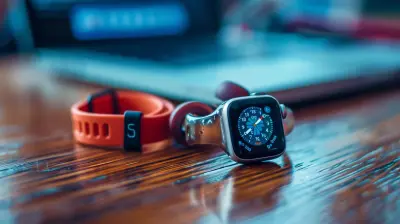
What Devices Will Replace Your Phone by 2027?
16 October 2026
Your phone is not going to vanish overnight. That is not how consumer hardware works. But the way you use it is already starting to split apart, and by 2027 the device in your pocket will likely be one screen among several rather than the center of your digital life. The question is not whether something replaces the phone in a single dramatic moment. It is which devices chip away at it first, which ones actually stick, and what that means for how you spend money and attention over the next few years.
I have watched enough hardware cycles to be skeptical of "the phone is dead" headlines. The phone survived smartwatches, tablets, and voice assistants because it does almost everything reasonably well. What is different now is that the supporting technology, mainly cheap sensors, on-device AI, and fast wireless links, has finally caught up to ideas that failed a decade ago. That changes the math.
Let me walk through the realistic candidates, what each one is genuinely good at, where it falls apart, and how to think about them without wasting money on hype.
Why the Phone Has Been So Hard to Displace
Before talking about replacements, it helps to understand why the phone held on for so long. A phone bundles five things into one pocketable object: a display, a camera, a microphone and speaker, a radio for connectivity, and a battery. Any challenger has to beat that bundle on convenience, not just on one feature.Google Glass failed in the consumer market largely because it did one thing (heads-up info) while making everything else worse, including social acceptability. Smartwatches succeeded because they did not try to replace the phone. They extended it. That is the pattern to watch. Devices that try to fully replace the phone tend to fail. Devices that absorb specific phone jobs tend to survive and then expand.
So when I say something might "replace" your phone by 2027, I usually mean it will replace a large share of your phone time, not the entire device. Keep that distinction in mind, because it is where most predictions go wrong.

Smart Glasses With Real Displays
This is the most credible near-term challenger. Meta's Ray-Ban glasses proved that people will wear a camera and audio device on their face if it looks normal. The next generation adds a display, and that is the tipping point.What they actually do well
- Hands-free capture: photos, short video, and notes without pulling anything out of a pocket.- Turn-by-turn navigation and live translation shown in your field of view.
- Notifications and message replies delivered without a screen in your hand.
The reason this works now and did not in 2013 is power efficiency. Display technology like waveguides and micro-LED lets you project a small image without a bulky prism. On-device AI handles translation and transcription locally, so you are not streaming everything to a server and draining the battery.
Where they fall short
Battery life is the hard ceiling. A display glasses frame has maybe a few hours of active use. Field of view is still narrow, so you get a small floating panel, not a full immersive screen. And the social problem has not disappeared. People still feel uneasy around someone wearing a camera with a screen.When to consider one
If your phone use is dominated by quick lookups, navigation, and messaging, glasses could replace a meaningful chunk of it. If you watch video, play games, or edit photos on your phone, glasses will not help you. They are a companion, not a substitute.
Standalone AR and VR Headsets
Headsets are further along than most people assume, but they solve a different problem. They are not portable in the way a phone is. You do not wear a headset on a bus.The real use case
Headsets replace the phone for work and entertainment at a fixed location. Virtual monitors, spatial video, and immersive training are genuinely better in a headset than on a phone. Apple's Vision Pro and Meta's Quest line show two different philosophies: one is a premium computing device, the other is a mass-market entertainment console.The honest trade-off
Weight, comfort, and isolation. You cannot wear one for eight hours without noticing it. And the price of a high-end headset still exceeds a flagship phone. For most people, a headset in 2027 will be a second or third device, not the primary one.If you work from home and stare at multiple monitors all day, a headset can replace your phone for meetings and your laptop for focused work. That is a real, defensible use case. It is just not a pocket replacement.
Earbuds and Hearables as a Computing Platform
This one gets underestimated. Earbuds already have microphones, sensors, and increasingly their own chips. The shift is that they are becoming an interface, not just an output.What changes by 2027
- Always-listening assistants that run locally and respect privacy boundaries.- Health monitoring: heart rate, temperature, and possibly blood oxygen trends.
- Real-time translation in your ear during conversation.
The reason this matters for phone replacement is that voice becomes a viable primary input when the assistant is actually good. Today's voice assistants are frustrating because they misunderstand context. On-device models are changing that. When you can say "text Sarah that I am running ten minutes late and ask if she wants coffee" and it just works, the screen becomes optional for a large class of tasks.
The catch
Voice is terrible in public. You will not dictate a private message on a crowded train. And earbuds alone cannot show you a map or a photo. They are a strong complement and a weak standalone replacement.Wearables That Are Not Watches
Smart rings and clips are quietly becoming serious. They track sleep, recovery, and activity with less bulk than a watch. The reason they matter here is that they normalize the idea of a body-worn device that is always on and always sensing.By 2027, expect these to feed data into a personal AI that lives across your devices. The ring is not replacing your phone. It is replacing the phone's role as your health dashboard.
The Real Replacement Is Not a Device
Here is the part most articles miss. The thing replacing your phone is not a single gadget. It is an ambient layer of computing that follows you across glasses, earbuds, a watch, and whatever screen is nearby.Think of it like electricity. You do not carry a power plant. You plug into outlets wherever you are. The same logic applies to computing. Your "phone" becomes a set of capabilities, and the hardware you touch depends on the moment.
What makes this possible
- On-device AI that runs without a constant cloud connection.- Fast, low-power wireless like Wi-Fi 7 and advanced Bluetooth.
- Standardized identity and data sync across devices.
What holds it back
- Fragmentation. No single company controls all the pieces, so the experience is uneven.- Privacy. An always-on ambient layer is a surveillance risk unless designed carefully.
- Cost. Owning four devices is more expensive than owning one.
This is why I tell people to stop asking "what replaces my phone" and start asking "which phone jobs can I offload, and to what." That reframing saves money and disappointment.
A Practical Comparison for 2027
| Device | Replaces phone for | Does not replace phone for | Maturity by 2027 ||---|---|---|---|
| Smart glasses | Navigation, capture, messages | Video, gaming, editing | Early mainstream |
| AR/VR headsets | Work, immersive media | On-the-go use | Niche but solid |
| Earbuds/hearables | Voice tasks, health, audio | Anything visual | Mature |
| Smart rings | Health tracking | Everything else | Mature |
| Foldables | Everything, in one device | Nothing, it is still a phone | Mature |
Notice that foldables appear on this list. That is deliberate. The most likely outcome by 2027 is that many people replace their phone with a better phone, one that unfolds into a tablet. The "replacement" narrative often ignores the boring truth that incremental improvement usually wins.
Common Mistakes People Make When Planning for This
Buying the first version of everything
First-generation hardware is for enthusiasts. If you need a device to work reliably for two years, wait for the second or third generation. The price drops and the bugs get fixed.Assuming one device will do it all
The whole point of the ambient shift is that no single device wins. If you buy glasses expecting them to replace your phone entirely, you will be disappointed. If you buy them to handle navigation and capture, you will be happy.Ignoring the subscription layer
Many of these devices depend on AI services that carry monthly fees. A pair of glasses might cost $300, but the translation and assistant features could add $10 to $20 a month. Factor that into your budget before you commit.Overlooking privacy trade-offs
An always-on camera and microphone on your face is a different risk profile than a phone in your pocket. Read the privacy policy. Understand what is processed on-device versus in the cloud. This is not paranoia. It is basic diligence.Best Practices If You Want to Get Ahead of This
1. Audit your actual phone use for a week. Note how much time is screen-based versus voice-based, and how much is at a desk versus on the move. This tells you which device to buy first.2. Start with the cheapest useful upgrade. Earbuds or a ring are low-risk entry points into the ambient ecosystem.
3. Prioritize devices that play well with others. Lock-in is the enemy of a multi-device setup.
4. Set a budget for the whole stack, not per device. The hidden cost is the sum, not any single item.
5. Test before you commit. Return policies exist for a reason. Wear the glasses for a full day before deciding.
What This Means for Your Next Upgrade
If you are due for a phone upgrade in the next year, buy the phone. Do not wait for a replacement that may not suit you. But do two things. First, choose a phone that integrates well with wearables, because that ecosystem matters more each year. Second, set aside a small budget to experiment with one adjacent device, ideally earbuds or a ring, so you learn what actually fits your life.By 2027, the most likely scenario is that you still own a phone, but you reach for it less. Your glasses handle navigation and quick capture. Your earbuds handle voice and health. Your headset handles focused work. The phone becomes the hub you return to, not the device you live in. That is not a dramatic replacement. It is a quiet, practical shift, and it is already underway.
all images in this post were generated using AI tools
Category:
Technology ReviewsAuthor:

Adeline Taylor